

This Erasmus Mundus Joint Master (EMJM) programme is delivered collaboratively by five 4EU+ universities. You will gain a firm disciplinary and interdisciplinary footing in both environmental economics and environmental policy and politics, equipping you to effectively design, implement, and analyse policy solutions for the complex environmental challenges facing European and international societies.
European Environmental Economics and Policy Joint Programme
1st year (60 ECTS) – Foundation
2nd year (60 ECTS) – Specialisation
Overview of programme structure
University of Copenhagen
Environmental Economics and Policy in Europe
Heidelberg University, Alfred Weber Institute for Economics
Advanced Environmental Economics
Heidelberg University, Institute of Political Science
Comparative Environmental Policy
The 2nd year programme in Comparative Environmental Policy at Heidelberg offers a specialization in the theory-led empirical assessment of the characteristics and drivers of environmental policy in Europe. The first term features a fixed set of three compulsory courses, amounting to 24 ECTS, and a restrictive elective course of 6 ECTS. The second term features the Master’s thesis (27 ECTS) and the joint thesis and employment workshop (3 ECTS).
|
Semester 1 |
Semester 2 |
|
*(if needed for list of restricted electives) |
|
|
Restricted elective subject elements (6 ECTS) To be covered as subject elements from the following list:
|
Compulsory courses:
To obtain 8 ECTS, the student will have to give an oral presentation (2 ECTS) and prepare a term paper of 5,000 words (6 ECTS). The oral presentation will be given during the course. The due date for the term paper is March 15.
Comparative Environmental Policy
Environmental policy encompasses all policy instruments designed to address environmental challenges. While these instruments can be categorized using universal frameworks (such as the NATO scheme, which distinguishes between nodality-, authority-, treasure-, and organization-based systems), their implementation and calibration vary across jurisdictions. This course introduces students to both conceptual classification systems for environmental policy instruments and their practical application in European Union (EU) member states. Students will also examine the domestic (e.g., political party preferences) and international factors (e.g., EU directives and international environmental agreements) that influence the selection and calibration of environmental policy instruments.
To obtain 8 ECTS, students have to achieve a minimum grade of 4,0.
Methods in Comparative Political Science
Political science employs a diverse array of empirical methods to systematically compare political institutions (polities), processes (politics), and outcomes (policies) both within countries (e.g., at subnational, provincial, or regional levels) and across nations. These methods serve to explain differences and similarities between observation units and enable researchers to identify trends, patterns, and regularities among them. This course introduces students to case-study design methods for comparative empirical research, including most-similar-systems and most-different-systems designs. Additionally, students will learn statistical techniques for analyzing cross-sectional, longitudinal, and time-series-cross-sectional data.
To obtain 8 ECTS, students have to achieve a minimum grade of 4,0.
Policy Design and Practice
Policy theories provide comprehensive insights into policy processes across diverse settings. This course teaches students how to effectively communicate these theoretical insights to broader audiences. Students will first explore leading policy process theories (such as the Advocacy Coalition Framework). They will then examine the distinction between policy scholars serving as ‘knowledge brokers’ versus ‘policy advocates’. The course will also teach techniques for presenting research findings in clear, accessible language, avoiding jargon and unnecessary complexity to enhance their potential impact. Finally, students will critically examine the actual and potential roles of policy studies and scholars in shaping public policy design and implementation.
To obtain 8 ECTS, students have to achieve a minimum grade of 4,0.
Elective courses:
To obtain 6 ECTS, the student will have to prepare a term paper of 5,000 words.
Performance of Democracies and Autocracies
This course examines the distinctive characteristics of democratic and autocratic regimes, exploring their operational mechanisms and analyzing the policy outputs and outcomes they generate.
To obtain 6 ECTS, students have to achieve a minimum grade of 4,0.
Theories of Public Policy
This course provides an introduction to fundamental theories of public policymaking. While focusing primarily on policy process theories, it also incorporates complementary theoretical frameworks that examine specific explanatory factors, such as the influence of political parties on policy outputs.
To obtain 6 ECTS, students have to achieve a minimum grade of 4,0.
Environmental Justice: discourses, concepts and theories in comparison
This course, situated within modern political theory, explores theories of justice and their application to contemporary environmental challenges.
To obtain 6 ECTS, students have to achieve a minimum grade of 4,0.
International Comparative Climate Policy
This course examines the landscape of national climate policies and introduces students to relevant policy databases, evaluating their utility for different research approaches.
To obtain 6 ECTS, students have to achieve a minimum grade of 4,0.
Comparative Conflict Analysis
This course explores the fundamental characteristics of conflicts and the conditions that lead to war. Students will develop a nuanced understanding of conflict dynamics and manifestations, examining both de-escalation pathways and factors that drive conflict escalation.
To obtain 6 ECTS, students have to achieve a minimum grade of 4,0.
Comparative Public Policy
While all governments produce public policies, these policies vary across countries, policy sectors, and time periods. This course examines the underlying factors driving policy variation and equips students with methodological tools for designing comparative public policy research projects.
To obtain 6 ECTS, students have to achieve a minimum grade of 4,0.
University of Milan
Climate Change and Energy Economics
The 2nd year programme in Climate Change and Energy Economics at the University of Milan is designed to equip students with the skills to navigate the complex interplay between economic systems and climate policies, emphasizing innovative, data-driven solutions to global and European environmental challenges. Through a rigorous curriculum combining economic modelling, environmental policy analysis, and exposure to the most recent literature on climate change and energy economics, students gain a comprehensive understanding of how economic policies can mitigate climate impacts and accelerate the transition to clean energy.
|
Semester 1 |
Semester 2 |
|
Compulsory subject elements (18 ECTS) |
Compulsory subject elements (30 ECTS) |
|
|
* Part of the MSc thesis for a total thesis work of 30 ECTS. |
|
Elective subject elements (12 ECTS) To be selected from the following list:
|
Charles University
Policies and Politics of Green Transition
The 2nd year programme in Policies and Politics of the Green Transition at Charles University in Prague, focuses on policy and political aspects of the green transition. Students on this track will, at the end of the first year of study in Copenhagen, choose one of two orientations for their second year at Charles University: Public Policy for Green Transition or European and Global Politics of Green Transition. Both orientations include the course Policy Analysis for a Green Transition in the first semester.
In the second semester, students choosing the orientation in Public Policy for Green Transition will specifically target analysis and problem-solving in relation to public policies toward the green transition. Further, they can create individual profiles according to their preferences in the choice of elective courses addressing various aspects of public policy (environmental policy instruments, policy evaluation, administrative or public economics context of the green transition, and so on) to better understand green transition issues.
Students choosing the orientation in European and Global Politics of Green Transition will instead study politics and political analysis in the context of European or global organisations addressing the green transition. Further, students can create individual profiles through their choices between elective courses concerning various aspects of politics and governance in the EU and global institutions related to the green transition. In both orientations, the choice of elective courses is restricted to ensure that, regardless of the orientation, all students in this mobility track acquire competences within both policy and politics. Both orientations further entail the option of doing an internship in an organisation involved in the green transition, which could help students with the choice of their diploma thesis as well as gain deeper insight into the topic of their thesis.
Students choose one of the two orientations during the break between the first and the second year of study.
Semester 1 |
||
Course code |
Course name |
ECTS |
JSM748 |
9 |
|
JSM753 |
15 |
|
Semester 2 |
||
JSM754 |
Diploma Thesis Seminar II (includes participation in the Joint thesis and employment workshop) |
15 |
Orientation in Public Policy for Green Transition |
||
JSM751 |
Understanding the Policy Process in the Context of Climate Change |
8 |
Orientation in European and Global Politics of Green Transition |
||
JPM956 |
8 |
|
Students can take the following restricted elective courses during both semesters, amounting to 13 ECTS in total.
Students from the Public Policy for Green Transition orientation will have to choose a minimum of 9 ECTS in elective courses from Group A and a minimum of 4 ECTS in elective courses from Group B.
Students in the European and Global Politics of Green Transition orientation will have to choose a minimum of 5 ECTS in elective courses from Group A and a minimum of 8 ECTS in elective courses from Group B.
List of restricted electives:
University of Warsaw
Economics of Green and Just Transition
What is the European Credit Transfer and Accumulation System (ECTS)
Profile and career
Graduate profile
Degrees awarded
Career opportunities
Interactive Mobility Map
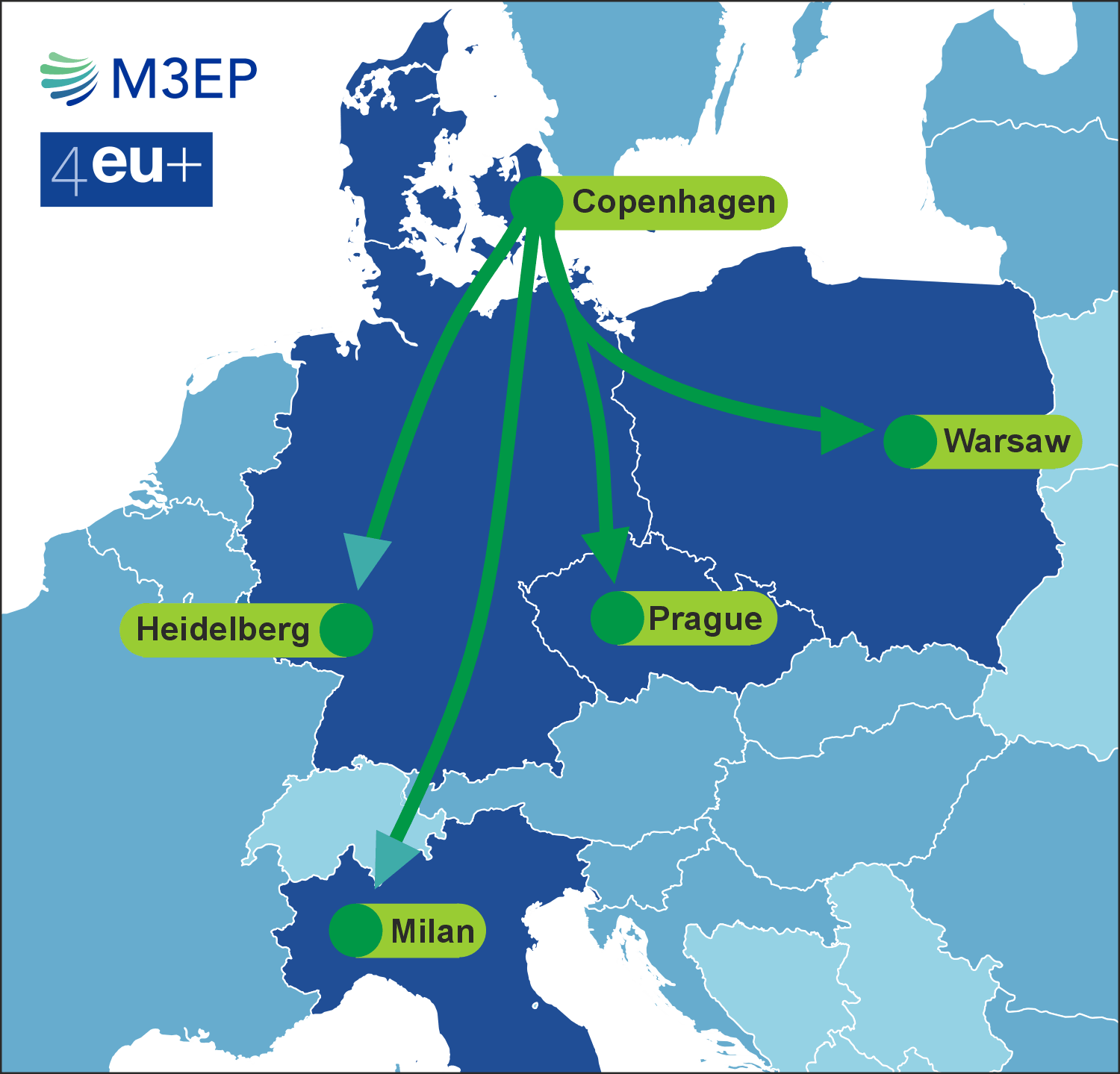



Heidelberg University (Germany)
Year 2 Specialization A: Comparative Environmental Policy
Year 2 Specialization B: Advanced Environmental Economics

Charles University (Czech Republic)
Year 2 Specialization: Policies and Politics of Green Transition